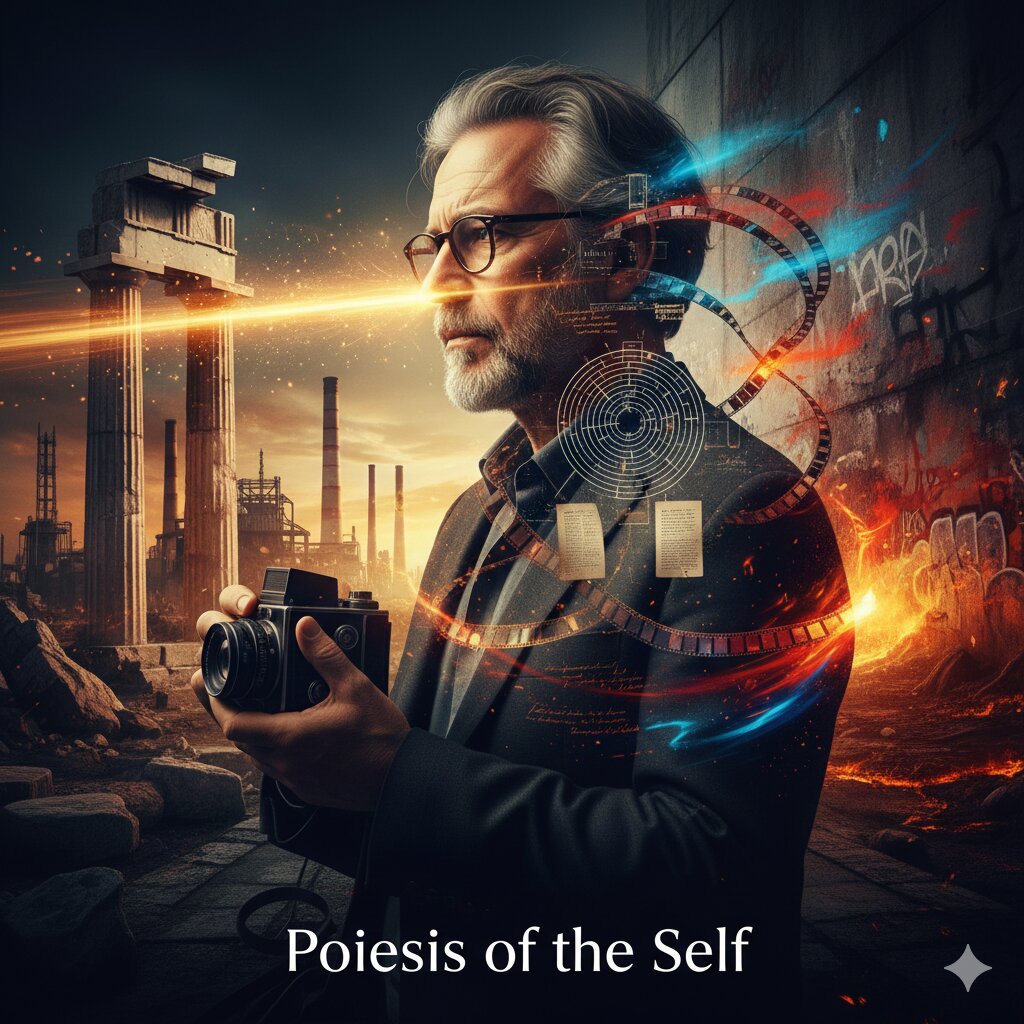
DG - Poiesis of the Self – The Filmic Gaze and the Art of Self-Invention
Traveling between Archaeology and the Aesthetics of Existence

From Excavation to Construction
The decisive shift in my work is a movement away from archaeology toward poiesis (aesthetics). No longer: What is my true self? But rather: How do I actively shape myself through lived practice?
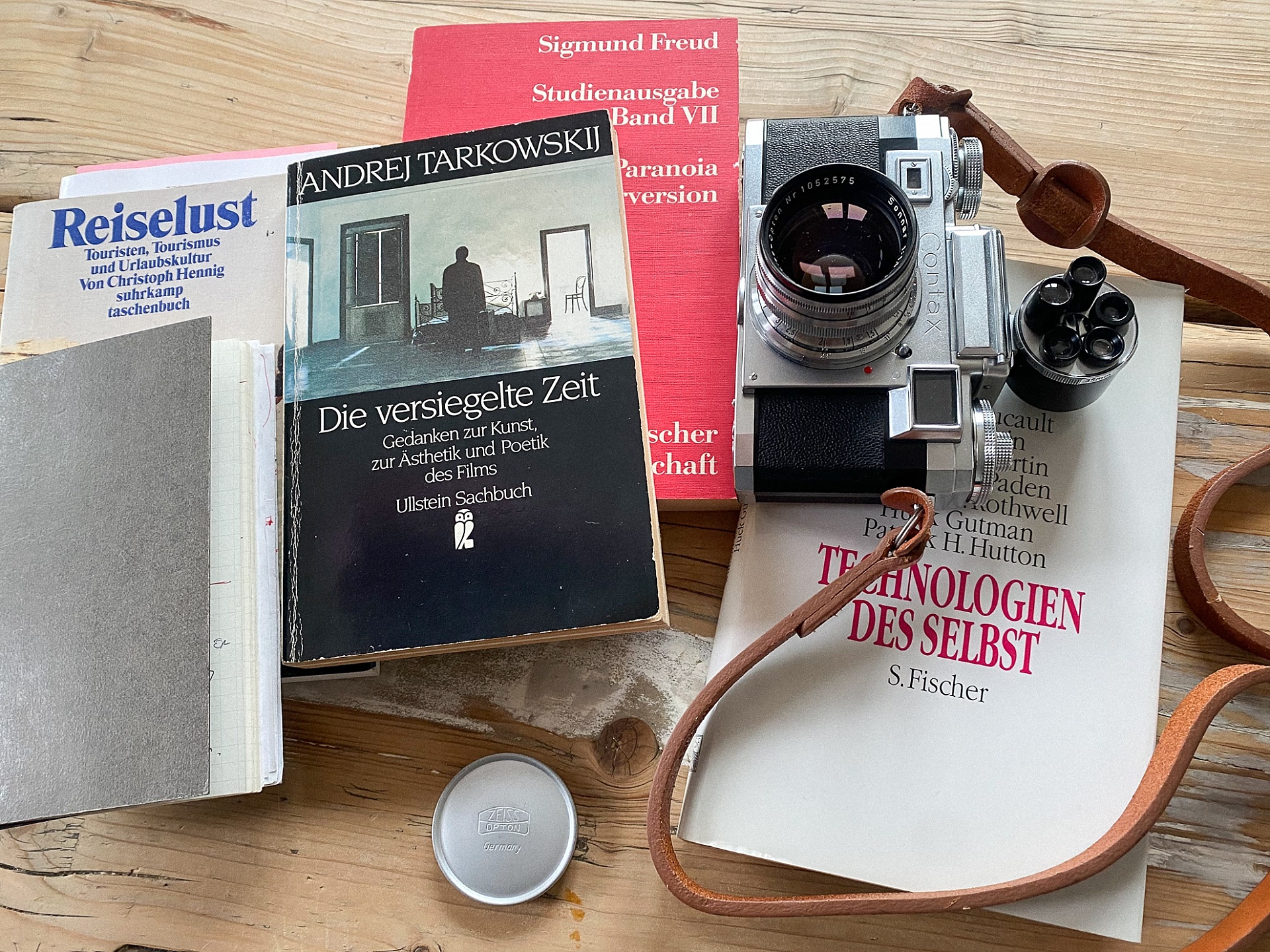
Drawing from the concept of “Technologies of the Self” developed by Michel Foucault, I understand truth not as something hidden beneath layers of history, but as something produced through disciplined acts of self-formation. Journaling, meditation, ethical exercises, travel, writing, filming—these are not accessories to a creative life. They are methods. They are instruments through which subjectivity is constructed.
The self is not discovered. It is composed.
Truth, in this sense, is not a fact waiting to be uncovered. It is a style of existence enacted through repetition, reflection, and deliberate exposure to the world.
Ancient practices—from Seneca to Marcus Aurelius—treated philosophy as technē tou biou, the art of living. Foucault radicalizes this insight: in a world structured by regimes of truth, self-practices are never neutral. They are both shaped by power and capable of resisting it.
The essential question is therefore not: Am I free?
But: How do I work with the forces that shape me?
Heidegger and Foucault: Excavation vs. Construction
At this point, a decisive philosophical tension emerges.
Martin Heidegger seeks “authenticity” (Eigentlichkeit)—a mode of being in which the individual frees himself from the anonymous “They” and returns to a more originary relation to Being. Truth appears as an uncovering, an unveiling of something concealed beneath everyday conformity.
Foucault refuses this metaphysical depth. For him, there is no hidden, pure self waiting to be liberated. There are only practices, discourses, and historically contingent formations of subjectivity. Freedom does not lie in uncovering an essential core, but in consciously stylizing one’s existence within the very structures that condition it.
Where Heidegger excavates, Foucault constructs.
Where one uncovers, the other invents.
My project situates itself consciously within this tension. I am not searching for an ontological essence. I am engaged in a continuous aesthetic operation.
The Filmic Gaze: Becoming as Narrative Structure
Travel, writing, and filmic narratives are not expressions of a pre-existing identity. They are my personal technology of self-making.
The camera is not a neutral recording device. It is an apparatus of becoming. When I walk through ruins, ports, industrial wastelands, or burned landscapes, I am not documenting the world as it is. I am articulating a perceptual logic—constructing a narrative structure within which I myself am reconfigured.
My refusal of authoritative voice-over is not a rejection of language, but a transformation of it. Explanation gives way to evocation. The edit becomes epistemology. Duration, silence, framing, interruption—these are the structural elements through which my worldview takes shape.
Becoming happens in the cut.
Identity is montage.
Truth is arrangement.
The journey is not geographical relocation; it is a shift in perception. Writing is not description; it is the condensation of experience into form. Film is not representation; it is the performative construction of reality.
Each project becomes a temporary configuration of the self. Each episode a structured experiment. The narrative is never closed; it remains episodic, provisional, revisable.
Power, Autonomy, and the Architecture of Identity
Foucault’s most unsettling insight is that we are governed not only by institutions, but by truths. Each epoch produces its own image of the “normal subject,” the “productive self,” the “authentic individual.” Even our search for meaning is historically conditioned.
The technologies of the self never exist outside these regimes. They are shaped by them. Yet they are also the only sites where transformation becomes possible. Power operates through the way we understand ourselves. But once this mechanism is recognized, a fissure opens.
Meaning is never purely “mine.”
But it is never entirely imposed either.
It becomes a practice—a stance toward the forces that attempt to define me.
Perhaps there is no metaphysical authenticity beyond all systems. But there is an aesthetic freedom within them: a freedom of form, of perspective, of narrative construction.
Not an escape from the world—
but a different way of cutting it.
Projection
My travels, my essays, my films are not a search for identity. They are laboratories of becoming.
I am not trying to uncover who I “truly” am.
I am constructing the conditions under which another version of myself can emerge.
Life is not an essence to be excavated. It is an ongoing edit—and I am responsible for the cut.